
Schools are better at safeguarding than they’ve ever been.
Attendance systems flag absences in real time. Safeguarding concerns are logged, tracked, and reviewed. Staff know which pupils should be where, and there are clear, practised processes for when something goes wrong.
Walk into almost any school today and you’ll find a safeguarding culture that would have been unrecognisable twenty years ago. The systems are more rigorous. The training is more thorough. The accountability is more visible.
And yet, there’s a part of every school day that sits largely outside that framework.
It happens twice a day, five days a week, for every pupil who doesn’t walk to school.
The journey.
Think about what happens the moment a pupil steps off school premises at the end of the day.
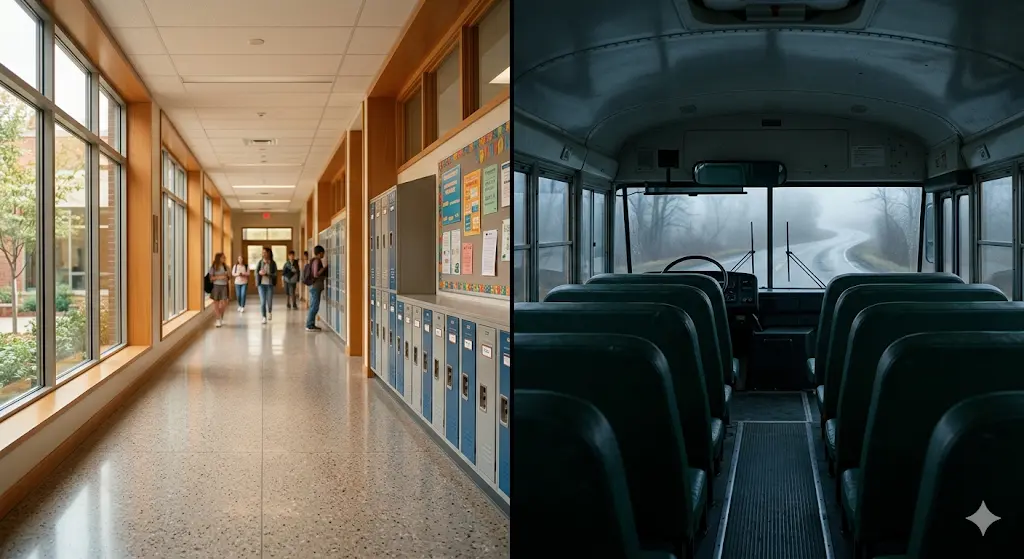
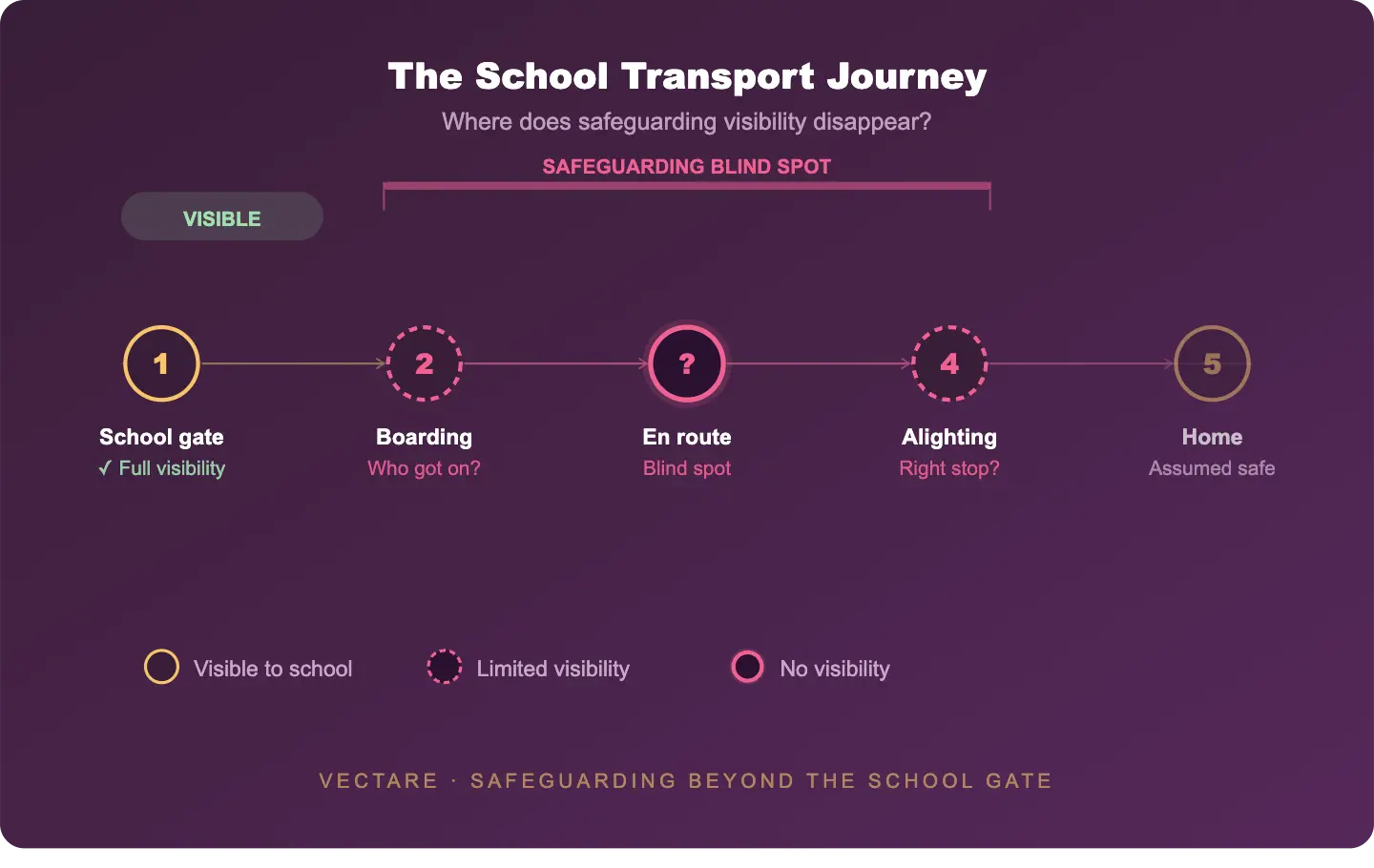
Inside the building, a school knows a great deal. Who’s present. Who’s absent. Who’s been involved in an incident. Who needs to be in a particular place at a particular time. That information is recorded, accessible, and, critically, actionable.
The moment that pupil boards a bus, the picture changes.
Does the school know which vehicle they boarded? Whether they sat down safely before it pulled away? Whether they got off at the right stop or stayed on, past their stop, without anyone noticing? Whether the bus is running twenty minutes late and a parent is waiting on a cold corner, increasingly worried?
For most schools, the honest answer is: not really. Not with any confidence. Not unless something goes wrong and someone picks up the phone.
That’s not a criticism. It’s simply how school transport has operated for a long time — largely on trust, familiarity, and the reasonable assumption that routine journeys stay routine.
The problem is that safeguarding, by definition, can’t rely on assumptions.
Part of the reason transport gets overlooked in safeguarding discussions is that it doesn’t sit clearly within anyone’s remit.
Safeguarding leads are rightly focused on what happens in school. Transport coordinators are focused on routes, vehicles, and costs. Bursars are focused on contracts and spend. Senior leaders are juggling a hundred other priorities. And so transport safeguarding — the question of what actually happens to pupils during the journey itself — falls into the space between all of them.
Nobody owns it. And when nobody owns it, nothing changes.
Add in the complexity of how many school transport networks actually operate (external contractors, multiple operators, mixed fleets of buses, minibuses and taxis, routes covering large geographic areas and multiple school sites) and the idea of maintaining real-time oversight can feel like a problem too unwieldy for any one person to solve.
So it doesn’t get talked about. Not because schools don’t care about their pupils’ safety on transport. Of course they do. But because without a clear owner, transport oversight stays on the periphery – a gap that’s always existed, and one that feels too embedded to close without significant investment or upheaval.
The result is a quiet blind spot. One that most school leaders are dimly aware of, but few have the tools, the mandate, or the framework to address directly.
Here’s what has changed.
Parents today expect real-time transparency across many parts of their daily lives. They track their online deliveries to the minute. They watch their taxi approaching on a map. They get push notifications when their flight begins boarding.
That expectation doesn’t disappear when their child gets on a school bus. If anything, it intensifies. A delivery being late is an inconvenience. A child being unaccounted for, even briefly, is something else entirely. For many parents, the school journey is precisely the situation where they most want visibility. Their child is travelling, potentially over a long distance, in a vehicle they didn’t choose, with a driver they may never have met.
When schools can’t provide that reassurance, the impact runs deeper than a poor experience.
For parents, it’s a moment of genuine anxiety. Their child is somewhere on a route they can’t see, and the school can’t immediately tell them where. That feeling, however briefly it lasts, shapes how a family thinks about the school, about communication, and about trust.
For staff, it’s an unwanted pressure point in an already demanding day. Chasing information across a chain of calls, trying to reassure a worried parent without the facts to do so confidently, compounds quickly when it happens repeatedly.
Peace of mind for parents and staff alike isn’t a soft benefit. It’s a meaningful outcome of having proper visibility over transport. When a school can answer the question “where is my child right now?” quickly and confidently, worry becomes reassurance. Uncertainty becomes trust.
The schools that are responding to this shift aren’t just improving the parent experience. They’re reducing stress, building confidence, and closing a genuine safeguarding gap in the same move.
It’s worth being specific, because “transport safeguarding” can sound abstract until you consider the situations schools actually face.
A Year 4 pupil boards the wrong bus at the end of the day. Two services depart from the same location, and in the rush, they get on the wrong one. Nobody notices until the parent calls, worried, forty minutes later.
A pupil doesn’t board at their usual stop. Their bus leaves without them. The school isn’t notified. The first anyone knows about it is when a parent calls to ask where their child is.
A pupil falls asleep during the journey and misses their stop. The driver doesn’t notice until the bus reaches its final destination. By that point, the child is confused, the parent is panicking, and the school is fielding calls without any way of confirming where the vehicle is or how long it will take to get the pupil home.
A vehicle is significantly delayed due to an accident on the route. Parents start calling. Staff have no way of confirming where the bus is or when it will arrive.
An incident is reported involving pupils on a school bus. The school needs to establish which pupils were travelling, in what order they boarded, and where the vehicle was at a specific time. Without digital records, piecing that together takes hours.
None of these scenarios are rare. They’re the operational reality of running school transport at scale. The question isn’t whether situations like these will arise. It’s whether the school has the visibility to respond quickly and confidently when they do.
The schools that are ahead of this haven’t necessarily made radical changes. They’ve simply extended their existing safeguarding thinking to cover the full student journey — not just what happens between the front door and the school gate.
In practice, that means being able to answer a set of basic questions quickly and without a flurry of calls, texts and emails:
When schools can answer those questions with confidence — in real time, from a single system — transport stops being a blind spot and starts being a properly managed part of the safeguarding picture.
The technology to achieve this exists. It’s not experimental or complicated. It’s being used by schools right now to monitor journeys, confirm boarding, communicate with parents automatically, and build digital records that can be accessed instantly when they’re needed.
The gap between schools that have extended their safeguarding oversight to transport, and those that haven’t, is beginning to widen. Not always in visible, dramatic ways. In quieter ones. In how quickly a concern gets resolved. In whether a parent trusts the school’s communication. In how confidently a leadership team can say, when asked: we know what happened on that journey.
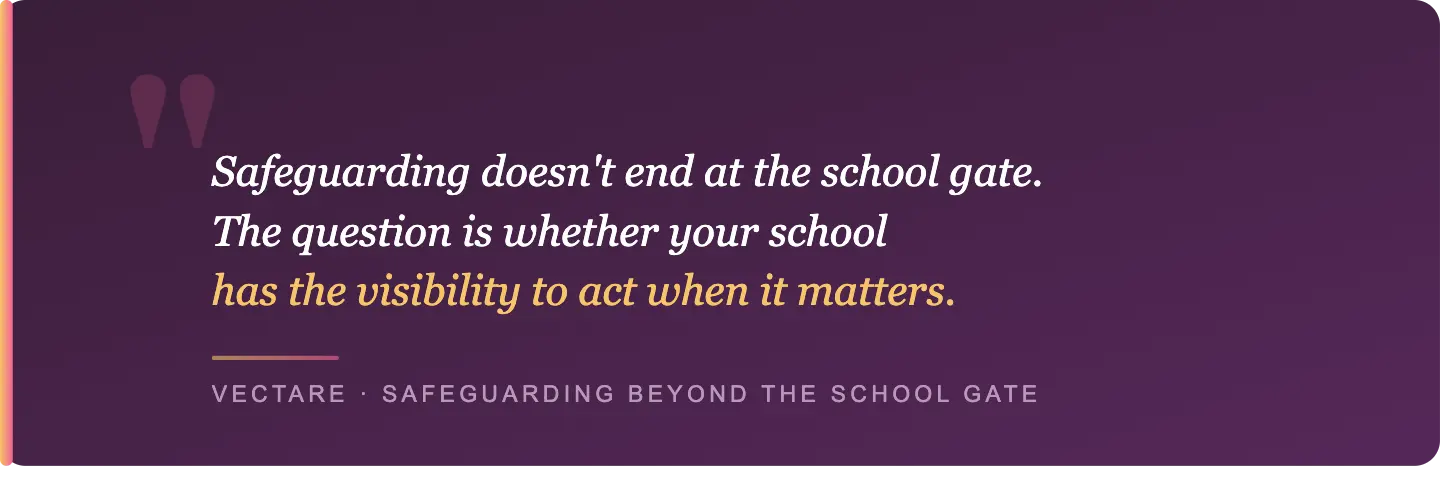
Safeguarding does not end at the school gate. The schools that recognise that are no longer treating transport as a logistical afterthought. They’re treating it as what it is: the first and last part of every pupil’s school day, and an important part of their duty of care.
Vectare was built specifically to solve the visibility problem in school transport. We work with more than 200 schools across the UK, and the challenges described in this article are ones our team encounters and helps resolve every day.
Our platform gives schools real-time tracking of every vehicle on their network, digital passenger registration via smartcard or QR code, and automated parent notifications for delays, boarding confirmations, and route changes. Drivers use a dedicated app to complete pre-journey vehicle safety checks and record boarding digitally, creating an instant passenger list that school staff can view from any device.
Every journey generates a reliable digital record. If a safeguarding concern arises — whether during the journey or weeks later — schools can access accurate information quickly, without relying on memory or manual logs.
That’s not a feature list. It’s the practical infrastructure that turns transport from a blind spot into a managed, accountable and more secure part of the school day.
Ready to think about what transport safeguarding looks like at your school? Arrange a demo with one of our experts today!


